Sensory-Motor Amnesia = Learned Habit
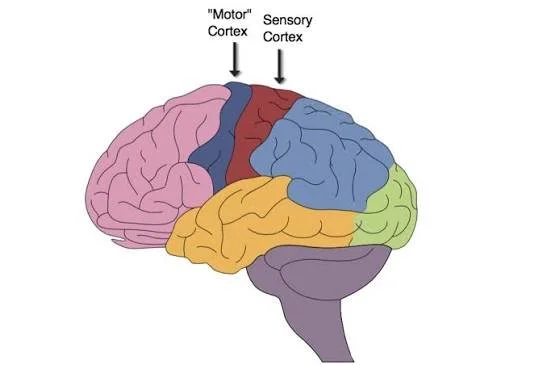
The Sensory-Motor Cortex — the comand centre of moving and sensing (feeling). From the brain (above) down the spine to the tailbone, the sensory nerves emerge from the back side of the spine and the motor nerves emerge from the front. The sensory nerves feed back information to the motor nerves, whose response loops back with movement commands along the motor nerves. Improving movement starts in the brain!
“Everything we sense in the world outside our bodies and everything we sense inside our bodies comes into our brain by way of the sensory nerves. Everything that we do in the world and every movement we make flows out from our brain down the spine by way of the motor nerves. The sensory nerves control perceptions of the world and of ourselves. The motor nerves control our movements in the world and inside ourselves by means of their attachments to the muscles of the skeleton and the smooth muscles of the viscera.” — Thomas Hanna, ‘Somatics’ (1988).
In his 1988 book “Somatics’ Thomas Hanna coined the term ‘Sensory-Motor Amnesia’ (SMA). Essentially, SMA is a partial or total loss (of memory) in our ability to both feel and move our muscles. SMA inhibits both movement quality and freedom by reducing muscle control and function. Muscles learn to stay tight or contracted, even when we sleep. All muscles have tone, or tonus, a natural elasticity to lengthen and contract in response to stimuli. If we lose voluntary control of a muscle or muscle group it can stay contracted (with higher tonus) to 10, 20 or even 40 percent. This is chronic muscular tension, rife in our modern, stressful world.
Long-term chronic muscular contraction is often felt as pain or tension in the body and many movement issues, and the accompanying pain, are caused by unconscious learned habit (SMA) not by abnormal structure. Tension and holding affects how we feel in our whole selves — anxiety, worry, fear, anyone? Or perhaps it shows up as that sense of being unable to stop or slow down? Thankfully SMA is a learned response and can be unlearned. Less tension in our body makes our whole self feel better. Remember in Somatics theres no separation between ‘mind’ and ‘body’ — we are a whole soma! Any one of us can reorganize function in reponse to learning or trauma thanks to neuroplasticity —the ability of the brain to be rewired by the input it receives.
So, how to we develop Sensory Motor Amnesia?
It’s all about habit. Habituation is the simplest form of learning.
SMA is a functional (rather than structural) issue within the sensory-motor system that impacts physical structure, posture, and movement. It develops when our responses to stress become ingrained. Humans habitually react to stress with three primary full-body reflex patterns:
contracting the back to move forward,
tightening the front of the body defensively or fearfully (often inhibiting breath)
or retracting / contracting the sides to avoid pain or danger.
Becoming stuck in these reflexes limits our ability to maintain balance and freedom of movement.
We can become stuck in these patterns due to repetitive action, injury, trauma, over-exercising, ongoing stress and more. When this happens, our brain loses its capacity to fully and voluntarily control your muscles and movements. This leads to a feedback loop where muscles operate on ‘auto-pilot’ — habit. This makes it challenging to manage them freely, both in the contraction and relaxation phases. This loss of control can lead to the onset of pain, movement issues, joint issues, arthritis, nerve impingement, and alterations in posture and structure. The resulting lack of physical autonomy can influence how we perceive ourselves and what we’re capable of. The good news is that we can regain our ability to self-sense, self-correct, and restore our previous range of functionality. We do this by re-educating our nervous system.
Somatic Movement classes are an educational process — this is NOT relaxation! Since SMA is a learned and functional issue, it can fortunately be ‘unlearned.’ Conditions like sciatica, scoliosis, or plantar fasciitis are often perceived by doctors as structural problems. Somatic Movement practitioners see these as reversible functional issues. We cannot resolve SMA through passive modalities (massage, acupuncture, Rolfing, or chiropractics) as these methods do not engage the brain. The brain is the control center that teaches the muscles to remain contracted. Retraining the brain is essential to learn to release and relax the muscles. While passive therapies have their benefits such as increased blood flow and pain relief, benefits are often short-lived. In contrast, improving sensory motor awareness through active education lasts a lifetime!
How can I learn Somatic Movement?
My weekly group Somatics classes and workshops take place at Cranberry Hall, Powell River, B.C. Somatics is (mostly) a floor-based practice —students lie on the floor on a mat or blanket to learn the movements, alternating between lying on the back, side, and stomach depending on the movement being explored. All Somatic Movement practitioners verbally guide the movements rather than demonstrate them. Eyes closed is best as one can feel the changes taking place and sense small differences. By not demonstrating the movements, we encourage this internal learning process. We make changes in your nervous system more effectively and efficiently when we focus completely on our internal sensations rather than on copying someone else’s movements.
Somatics classes are generally very relaxing and enjoyable. The mindful, slow, gentle, self-care movements that are suitable for all ages and fitness levels (as long as one can get up and don from the floor). Regular home practice is encouraged to relieve pain and tension, improve posture, increase range of motion, prevent injuries, relieve stress and foster a deeper sense of connection to oneself. The sense of self-efficacy students often feel is remarkable — students learn a toolkit of movements for greater resilience and adabtability through life’s ups and downs.
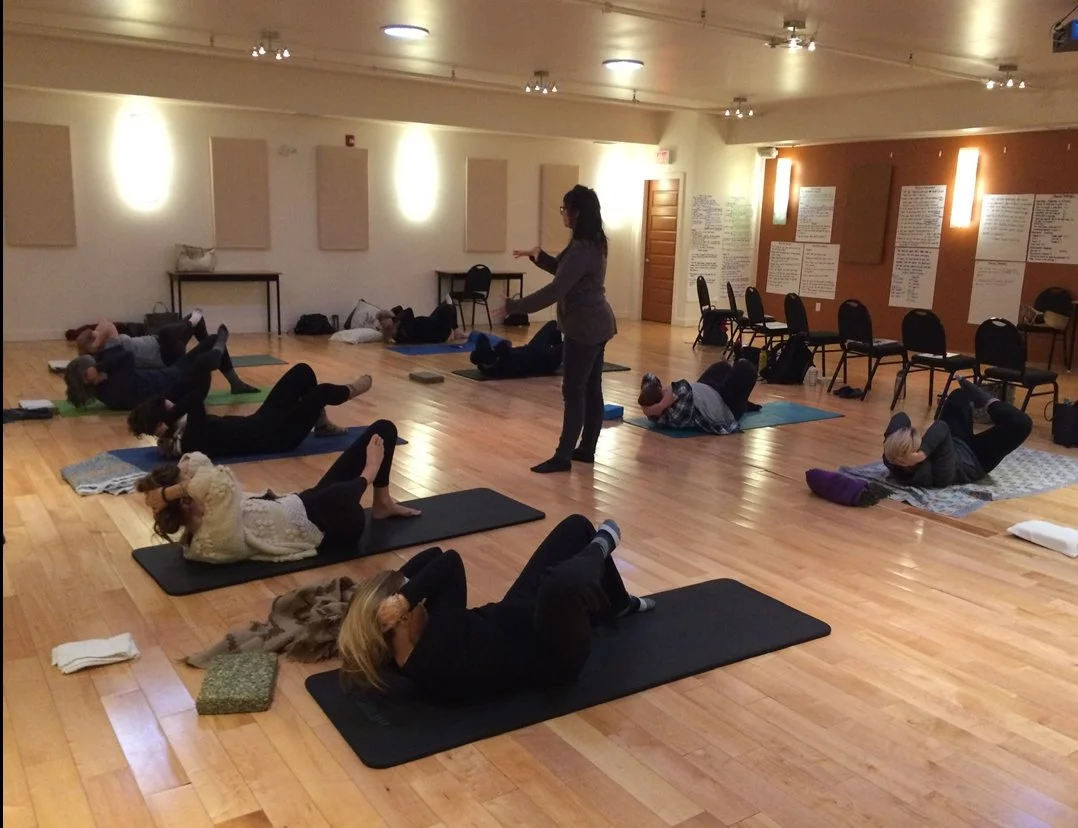
A Somatic Movement class in action!