Emerging with Ease
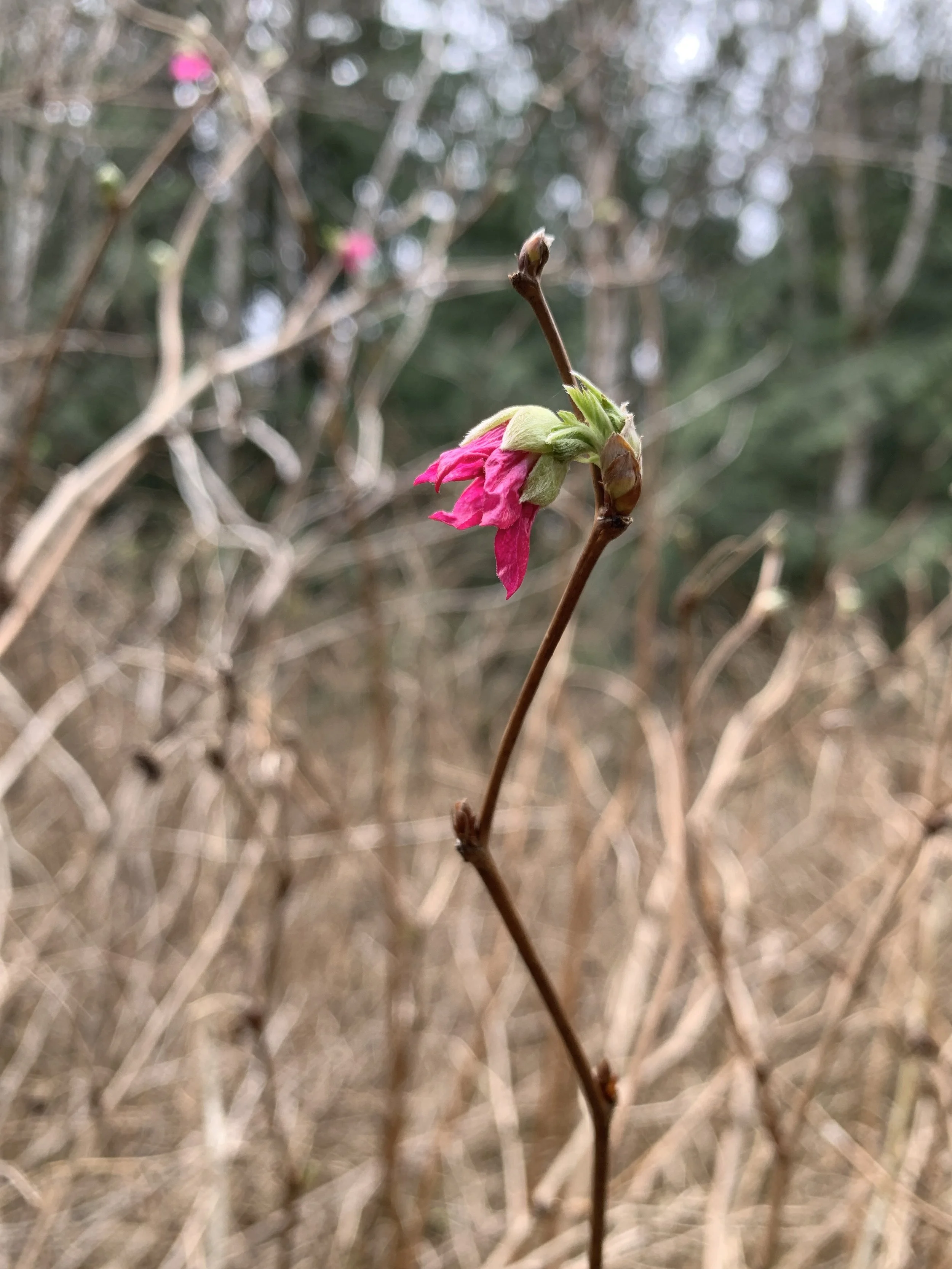
A Salmonberry flower slowly emerging. Haslam Lake, Powell River, B.C.
It’s officially Spring here on BC’s West Coast. That fickle time of year when one minute the sun is warming your bare skin and the next minute it’s hailing. I feel a little like this brave Salmonberry flower — cautiously emerging from the quiet, interior months of winter, with an energy that’s not quite there yet. The light has been steadily returning since Imbolc at the beginning of February, with life gaining momentum again. Slowly.
Us humans don’t do slow. Our pervading cultural ideology promotes speed, efficiency and productivity not only as a necessity but as a status symbol. We become caught in habitual modes of doing, caught up in the surrounding urgency culture. We forget that our nervous systems are ancient and not evolved for the frantic pace of modern life — what a remarkable ability we have to we override this and push through anyway! Nervous tissue first evolved in wormlike organisms 550 to 600 million years ago, evolving to manage environmental changes, and over millions of years branched into the complex central (brain/spinal cord) and peripheral (nerves) we have today. We forget, that lying underneath our vast intelligence, our brain and nervous systems are still primitive in many ways and intertwined with nature’s rhythms and cycles.
My husband and I moved from the busy Sea to Sky corridor to Powell River BC eight years ago in June. The slower pace of life suits us well; our community is remote and ony accessible by sea or air, so it retains an island like vibe. Driving off the ferry and back into town along Marine Avenue after a trip I literally feel my nervous system drop down a notch. Ahhh!
We spent the last two weekends out of town, firstly in Vancouver for two nights, then a day trip up to Campbell River on Vancouver Island. All travel involves lots of sitting, and these days, for many of us, staring at screens! It always blows my mind how the majority of ferry passengers stay seated inside the passenger deck or their cars, habitually hijacked by phones in many cases. Personally and no matter the weather, and being a true Yorkshire Lass(!) I always head out to the ferry deck and find a sheltered spot to practise a little Somatics and walk.
Freedom! Ocean and snow-capped mountains all around. Seagulls soaring and sometimes humpback whales or a pod of orca. AND the freedom to move! To breathe in the fresh sea air, to absorb the sounds of nature, to feel the wind on my skin. Using my sensory awareness, I feel truly alive, in awe, grateful. Canada’s great vastness sprawling out in all directions. All experienced via exteroception — how I percieve the world around me via my senses (as contrasted with interoception, the sense of how I feel from within).
Not all forms of transport involve the option of walking about though, so it’s often the front of our bodies that bears the brunt when travelling due to lengthy periods of sitting. Tension in the front (Red Light Reflex in Hanna terms) is quiet. It doesn’t shout like the back, but having an awareness of it is vital, or tension (pain, even) creeps up insiduously. This full-body pattern restricts our breathing, which contributes to fatigue, anxiety, neck pain, HRV issues and much more. I’m always so grateful for knowing a repertoire of Somatic Movements to release the muscles of the front in particular after travelling when I arrive home with my chest caved in and shoulders around my ears!
This ‘slumping’ pattern, in simple terms, tightens our flexor muscles of the front, across the chest, down the abdomen, hip flexors, the insides of our thighs and the neck, which gets pulled forward, shortening the back of the neck which means we lose neurological connection to our upper backs (vital for easy, upright standing).
Over time this pattern becomes habituated — unless we practise regularly. Here are some suggestions for movements to soften and regain control of the muscles of the front after a long trip (or a long winter!) using pandiculation — nature’s natural reset.
Flatten and Release
The Curl
The Flower
Psoas Release
Floating Ribbons
Side Sweep
Explore gently. Listen deeply. Unfurling ourselves after a long trip (or the long winter months!) can take time. Patience, persistence and regular practice will help. Remember, nature doesn’t hurry. Neither should we.